
Progressive Energy, Mission Zero Technologies, and Airhive join forces to develop a 60,000 tonne per year direct air capture plant at the industrial decarbonisation cluster on Teesside
Progressive Energy, Mission Zero Technologies, and Airhive join forces to develop a 60,000 tonne per year direct air capture plant at the industrial decarbonisation cluster on Teesside
A leading UK low-carbon project developer has joined forces with its two most advanced direct air capture (DAC) technology companies in a consortium that will build one of the world's largest facilities for capturing carbon dioxide directly from the atmosphere.
The UnionDAC project will make the UK a global leader in an emerging technology that is crucial to climate mitigation and to building a future low-carbon economy. The International Energy Agency forecasts a need for up to 980 million tonnes of CO2 removed from the atmosphere through direct air capture by 2050, implying a market worth over $100 billion annually by then. DAC facilities today remove under 100,000 tonnes per year globally.
UnionDAC’s partners blend technological expertise with experience in project development and operations. They are:
Progressive Energy: a recognised expert in developing and implementing projects that bring new, often technically challenging technologies to market. The company originated the development of the HyNet in the northwest of the UK. Now in construction, HyNet is a hub for carbon capture, power generation, green hydrogen and blue hydrogen projects.
Airhive: a London-based DAC developer that has pioneered a low-cost DAC technology using fluidised beds and a mineral sorbent. The company operates a plant in Teesside, England at Teesside University’s Net Zero Industrial Innovation Centre and has demonstrated its system at commercial scale in Alberta, Canada.
Mission Zero Technologies: a London-based electrochemical DAC technology developer with operating experience and low costs tied to its optimised energy requirements and mature supply chains. The company operates the first commercial DAC plants in the UK in Sheffield and Norfolk as well as a plant in Alberta, Canada.
The UnionDAC project’s first phase, with a combined 20,000 tonnes per year of capacity, is expected to launch by 2030. A second phase is expected to add 40,000 additional tonnes per year of capacity by 2032.
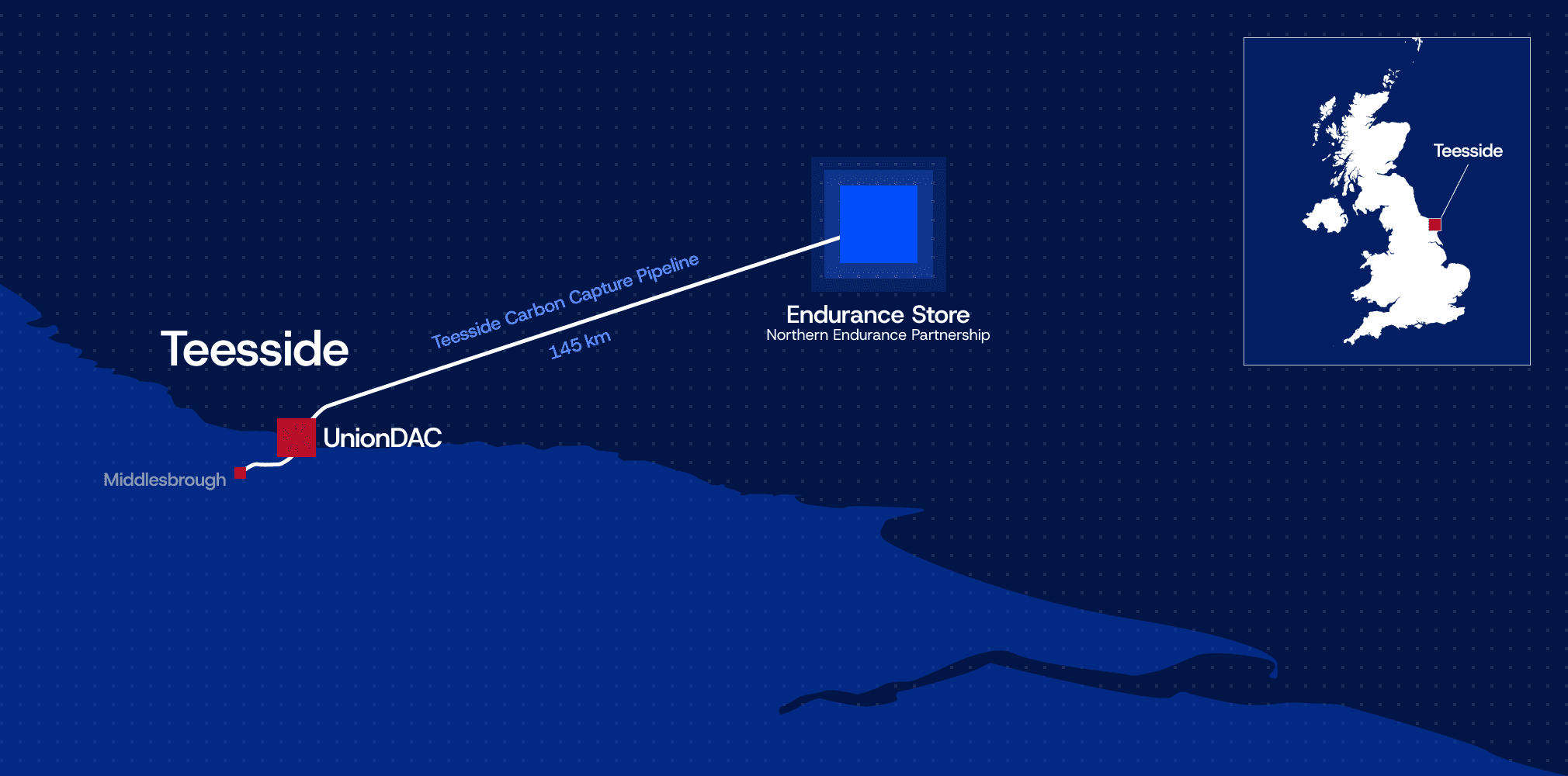
The combined 60,000-tonne-per-year DAC facility will be at the Wilton International site on Teesside in the northeast of England. This will add a new sector to Teesside’s growing industrial decarbonisation hub, already one of the leading clusters of its kind in the world. UnionDAC intends to connect to the carbon capture and storage infrastructure of the Northern Endurance Partnership. Using pipelines that run over 100km out to the North Sea from the Teesside cluster, NEP will soon start transporting CO2 from industrial emissions for safe and permanent storage deep below the seabed.
Chris Manson-Whitton, CEO of Progressive Energy said: “Progressive strongly believes that DAC has an important role to play in the low carbon economy of the 2030s and beyond. UnionDAC is a fantastic opportunity to play a role in a high growth, low carbon opportunity.”
Nicholas Chadwick, CEO of Mission Zero, said: “We believe the UK possesses the perfect combination of excellence in innovation, infrastructure, and skills to champion a playbook for economic growth coupled with decarbonisation. UnionDAC exemplifies what the next chapter of that looks like for the 2030s by bringing together bankable DAC technologies in a landmark endeavour.”
Rory Brown, CEO of Airhive, said: “Direct air capture technology has reached a point of take-off to deliver impact at scale across the UK and the world. But this requires smart project design. Joining forces with other sector leaders makes sense when government, technology providers, and investors have interlocking roles in scaling DAC before 2030.”
UnionDAC will support delivery of the UK government’s net zero goals as well as its climate leadership on the world stage. It will help the country meet its carbon budget by delivering substantial domestic carbon removal capacity by 2032. The seventh (and most recent) Carbon Budget from the UK Climate Change Committee forecasts 10 million tonnes of DACderived carbon removal annually by 2050, up from domestic production levels that are a fraction of that today.
The UK government – like those in the European Union, Japan, the state of California, and elsewhere – is expected to stimulate demand for DAC before the end of this decade by integrating carbon dioxide removal credits into compliance-based emissions trading systems tied to national net zero targets.
Carbon dioxide captured directly from the atmosphere can also be used for industrial applications in the food and beverage, medical, and other industries. The utilisation option for DAC has enhanced its value to governments and companies who want to mitigate climate change and strengthen domestic supply chains by investing in one technology set.
Additional resources
Press contact: Will MacNamara, will@gibboncomms.com
Progressive Energy: Website and Linkedin
Mission Zero: Website and LinkedIn
Teesside and its industrial decarbonisation hub: Website
Photos: On request